

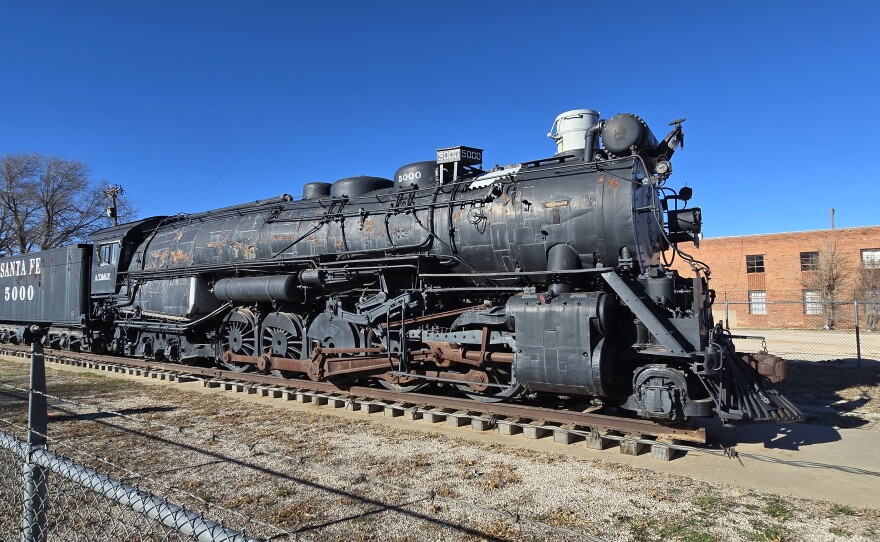
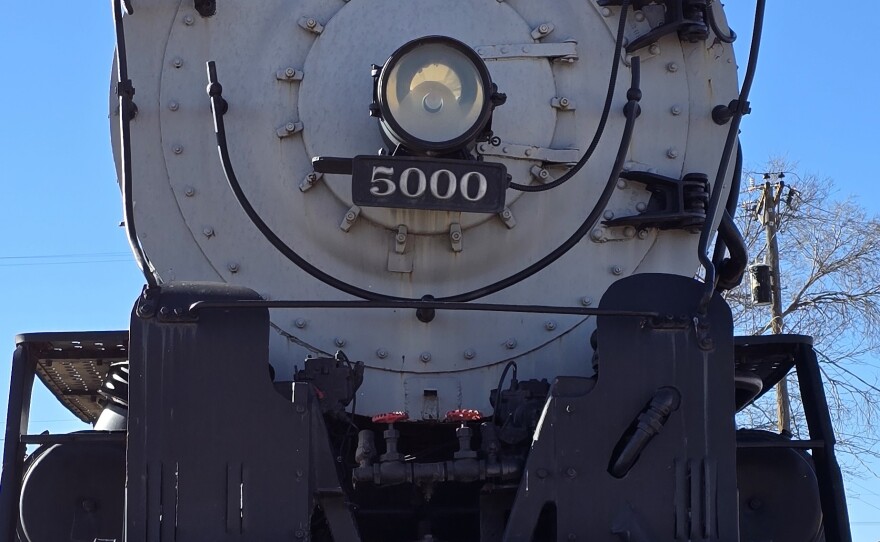
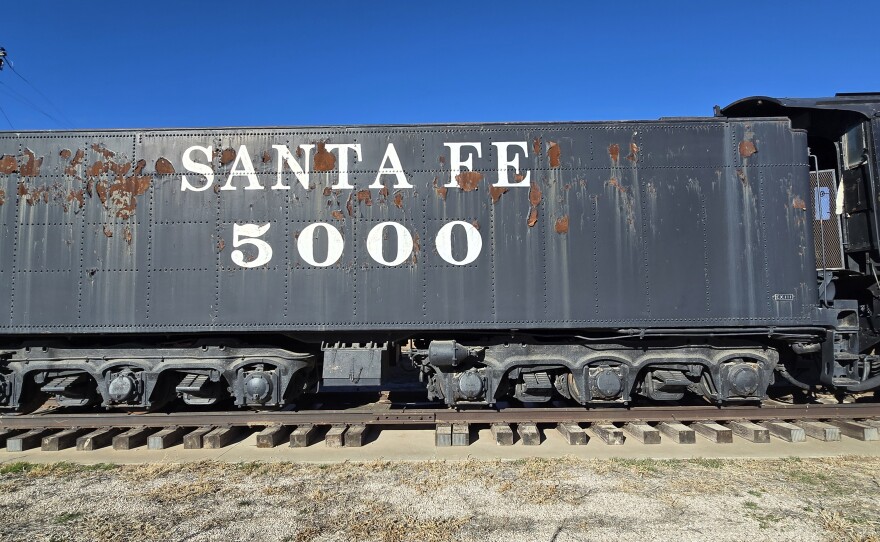
There is a beast sleeping north of the Amarillo Civic Center Complex that once breathed fire and belched smoke as it roared down the Llano Estacado — one of many that roamed the plains. This creature was no vicious monster of mythology; rather, this was a 877,000-pound machine made of iron and steel. In her prime, she was the height of technological innovation on the Atchison, Topeka, and Santa Fe Railroad (ATSF). The beast has a number, ATSF 5000. More famously perhaps, she has a name that reflects her high status and the respect she garnered from the people who worked on it, “Madame Queen.”
Much like the dragons of JRR Tolkien’s The Lord of the Rings, the Madame Queen and her steam-powered siblings are now relegated to legends passed down across generations. Their days have long since passed, but their stories remain an integral part of the history of the High Plains. What follows is a brief history of the Madame Queen, the once-reigning monarch of the ATSF Railroad and a perennial reminder of just how much human transit and the movement of goods in this country has changed over the past century.
In the late 1920s, railroads all across the country were hard at work ramping up the power of their locomotives. The demand for powerful steam engines to haul the agricultural and mineral resources extracted in the hinterlands increased in kind, especially as these goods were destined for disparate urban, industrial centers experiencing unprecedented population booms. The ATSF, in an effort to remain competitive, set out to work on the next generation of locomotives that it hoped would set the standard for freight hauling for the next decade.
The railroad needed something more powerful than its fleet of 2-10-2 locomotives — that is, locomotives with two leading wheels, 10 driving wheels, and two trailing wheels. ATSF had undertaken an experiment in 1919 with locomotive No. 3829. This prototype was a 2-10-2 modified with an extra axle of trailing wheels in a 2-10-4 configuration — a first in the United States. The added wheels were indeed a success, allowing for heavier and more powerful steam engines to be used. In light of the results of that experiment, the ATSF decided to continue exploring what would eventually be referred to as the “Texas Class,” and use that as the basis for its new generation of freight power.
In 1930, Baldwin Locomotive Works delivered the ATSF 5000 in what was to be the first of the new class of heavy-freight locomotives. The brand new model almost immediately received a loving nickname: “Madame Queen.” The alias was taken from a character on the radio show Amos & Andy, which was popular among railroad crews. With her 10 driving wheels (69 inches each), and a boiler capable of producing 300 psi, the new engine performed admirably in service hauling massive freight trains on ATSF’s Pecos division.

While the 5000’s performance was everything the company hoped it would be, she would remain the only Texas Type in service with the ATSF for the next eight years. The Great Depression stymied the development of the new fleet of 2-10-4 locomotives but also allowed Baldwin and ATSF to assess the 5000 before work began on her sisters, and make some improvements to the design. By 1936, economic conditions had improved to the point that ATSF was comfortable ordering more Texas Types, all with a handful of improvements over the 5000. These 10 new locomotives were different enough from the 5000 that they were designated the 5001 class, cementing the Madame Queen literally in a class of her own.
The 1940s were perhaps the apex of the Texas Type locomotives. Madame Queen herself would receive an upgrade in 1940 that replaced the traditional, coal-burning firebox with a new one that used oil as fuel, and with that, a new tender for storing said oil. In 1943, as World War II continued to burn in Europe and the Pacific, the railroad looked to bolster its fleet with then state-of-the-art diesel electric engines. Wartime regulations put in place by the federal government, however, forced the railroad to instead purchase 25 more Texas Type engines. Like their predecessors, this new batch would incorporate further improvements made to the 5001 class, receiving a designation of 5011. These upgraded engines were crucial to the war effort throughout the southwestern United States, transporting materials quickly and reliably, making them the backbone of ATSF’s freight network.
As diesel-electric engines began to come to prominence, the need for large steam locomotives of the past was waning. Hence, the story of the Texas Types as working engines came to an end in the 1950s. Madame Queen herself was retired in 1957 after almost three decades of service, totaling 1,750,000 miles of freight transportation. That same year, her majesty was donated to the city of Amarillo and remained on display near the Santa Fe Depot for a number of decades. In 2005, the locomotive was moved to her current location on SW 2nd Ave., across the street from the north parking lot of the Civic Center Complex – which is where she remains to this day. Various proposals for restoration, both cosmetic and functional, have been put forward by preservationists over the years, but none have come to fruition. Time will tell what the future has in store for the once mighty beast of the ATSF system, but the memory of her regal service will live on for future generations of rail enthusiasts and Amarillo citizens.
If you haven’t experienced first-hand the majesty of the Madame Queen, you can find her at 500 SE 2nd Ave. in downtown Amarillo. While you’re there, take a selfie, send them to me at ncrawford@hppr.org, and you just might see them on our Instagram and Facebook feeds!